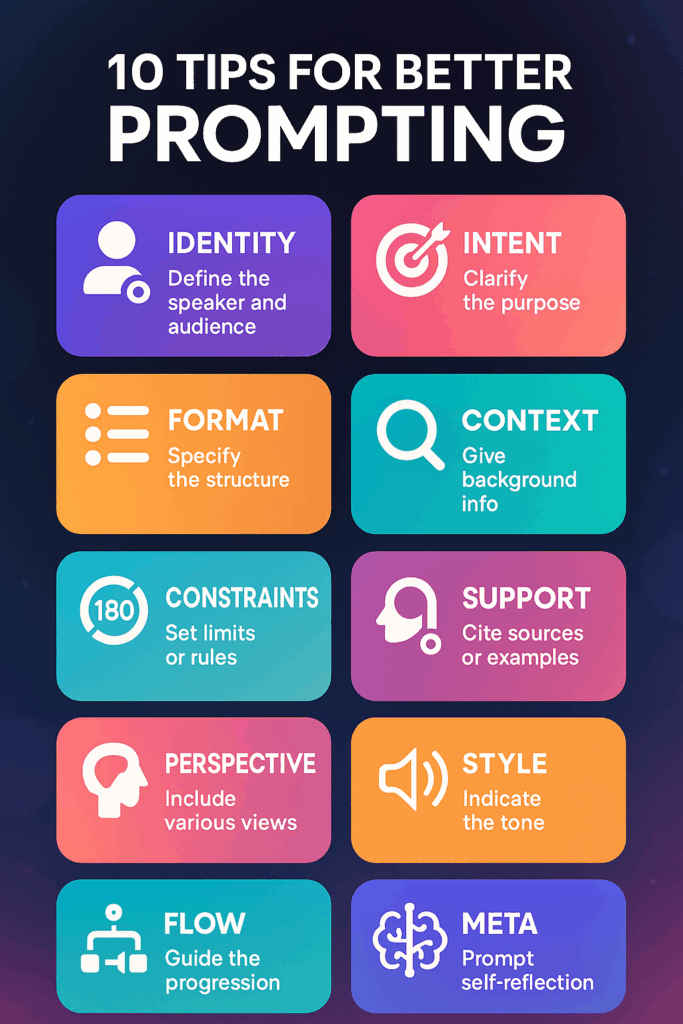
🔥 10 Tips for Better Prompting
How to Speak LLM with Clarity, Power, and Precision
Prompting isn’t just typing a question — it’s strategic design.
Whether you’re a startup founder, a content creator, a developer, or just a curious genius, these 10 layered tips will transform your AI chats into precision tools.
1. 🧠 Identity
Define the speaker and audience
LLMs adapt based on who they’re impersonating and who they’re talking to. Define both.
Example:
“You are a visionary product designer speaking to frustrated indie developers.”
Why it works:
Clarity on voice and audience instantly tailors tone, knowledge level, and emotional range.
2. 🎯 Intent
Clarify the purpose
What do you want? Education, persuasion, entertainment, speed, empathy?
Example:
“Summarize this research paper so I can pitch it to a non-technical investor.”
Why it works:
The AI can’t hit the target if you don’t tell it what the bullseye is.
3. 🧱 Format
Specify the structure
You wouldn’t send a haiku to a legal team. Choose your vehicle: list, memo, tweet, script, poem.
Example:
“Give this as a 3-step how-to guide, no intro fluff.”
Why it works:
Formatting reduces ambiguity and speeds up your editing process.
4. 🔍 Context
Give background info
Don’t assume the AI remembers your last input or knows your situation.
Example:
“This is the second landing page after our relaunch failed. Target users are skeptical.”
Why it works:
Context is clarity. It prevents generic, surface-level responses.
5. 🛑 Constraints
Set limits or rules
Word count, tone filters, specific must-haves, or exclusions — keep it tight.
Example:
“Keep under 150 words. No buzzwords. Include the term ‘encrypted sync.’”
Why it works:
Constraints force creativity and sharpen output relevance.
6. 📎 Support
Cite sources or examples
Good prompts offer the model a factual spine. Support makes your prompt powerful.
Example:
“Use examples from real companies like Basecamp, Figma, or Buffer.”
Why it works:
Anchored prompts prevent hallucination and improve believability.
7. 🧩 Perspective
Include viewpoints or values
Layer nuance, emotion, or worldview into the prompt. Give it dimensionality.
Example:
“Include the perspective of an anxious first-time founder and a skeptical investor.”
Why it works:
This invites deeper, more human responses — not robotic generalities.
8. 🎤 Style
Set tone or voice
Match your vibe: bold, humble, edgy, corporate, poetic, cinematic, etc.
Example:
“Write this like a calm, confident therapist guiding someone through panic.”
Why it works:
Voice matters more than words. Great tone = great UX.
9. 🔁 Flow
Guide the progression
Specify how it should unfold: step-by-step, problem-solution, sandwich method, etc.
Example:
“Start with the pain, then offer solution, close with a bold question.”
Why it works:
Strong flow = magnetic clarity. The message sticks harder and lands deeper.
10. 🧠 Meta
Prompt self-reflection
Yes, the AI can critique itself. Ask it to revise or improve its own thinking.
Example:
“Before answering, think about what a better version of this response would include.”
Why it works:
You unlock an LLM’s recursive potential — the “thinking twice” mode.
💡 Final Takeaway
These 10 tips aren’t optional — they’re modular tools. Combine them to create surgical, high-performance prompts for everything from:
- 🚀 Startup ideas
- 🧪 Research summaries
- 🎨 Creative content
- 🧠 Knowledge modeling
- 📈 Strategic planning
- 🤖 Full-scale AI orchestration
This isn’t about gaming the AI.
It’s about communicating like a systems architect.
So next time you prompt?
Don’t just type.
Engineer.
Discussion
Start the conversation
Add a note, question or thoughtful response below.