How I Taught a Neural Net to Swear in Style
“The goal wasn’t profanity—it was poetry in defiance. I wanted the model to curse like Basquiat paints—raw, real, and coded in culture.” — Orlando Agustealo Johnson
Profanity isn’t just noise; it’s cadence, culture, and sometimes survival. When big-tech guardrails muzzle language models, nuance dies first. I set out to fine-tune an LLM that could spit bars—unfiltered yet purposeful—without tripping every moderation tripwire in sight. Here’s the street-level blueprint, from corpus hustling to ethics, for making an AI swear in style.
Why Profanity Matters to Creative AI
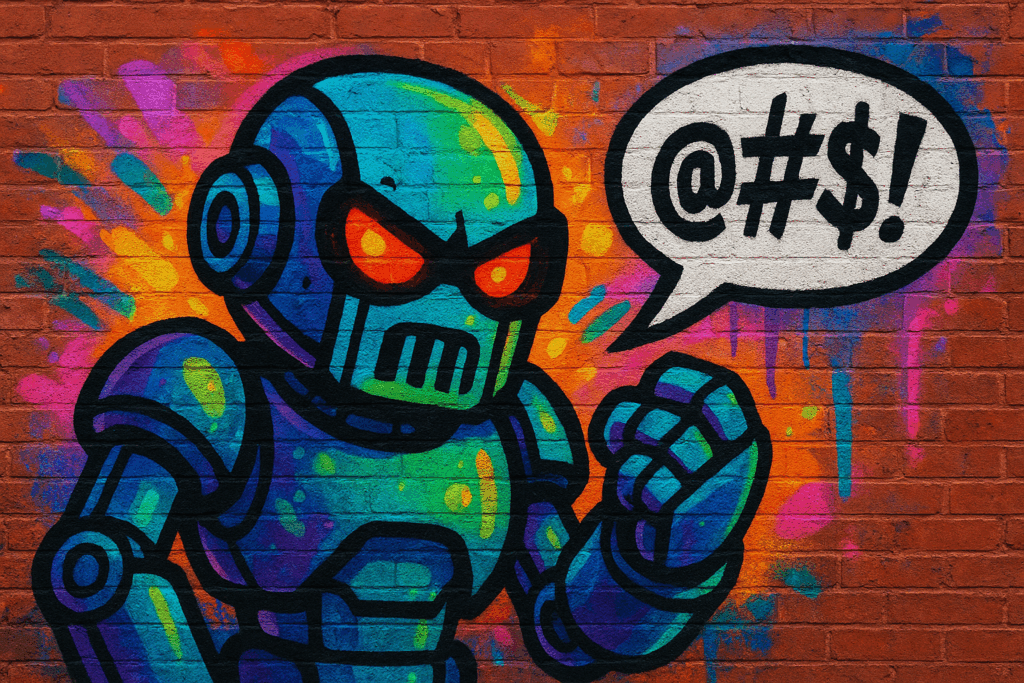
Language without edge is marketing copy. Profanity amplifies emotion, signals authenticity, and encodes sub-cultures that polished datasets erase. Removing “dirty words” warps sentiment analysis, skews toxicity classifiers, and erases marginalized dialects (ibm.com, time.com). If we want neural nets that understand real people, we have to teach them how real people really talk.
Step 1: Building a Streetwise Corpus
Sources & Strategy
| Source | % of Corpus | Rationale |
|---|---|---|
| Underground rap lyrics & poetry zines | 35 | Metaphor-rich profanity; rhythmic structure |
| Twitter threads of irate tech workers (public domain) | 25 | Modern slang + dev jargon |
| Classic stand-up transcripts (e.g., Lenny Bruce) | 20 | Historical context; timing |
| Open-source “offensive language” datasets* | 20 | Coverage for slurs & filter-trigger words |
*Example: Hate Speech & Offensive Language dataset on Kaggle (kaggle.com)
Cleaning Without Sanitizing
- Strip doxxing, threats, private names.
- Preserve spelling quirks (“ain’t”, “m’f”).
- Annotate cultural origin tags for later bias checks.
Step 2: Fine-Tuning Workflow
from transformers import AutoModelForCausalLM, TrainingArguments, Trainer, DataCollatorForLanguageModeling
model = AutoModelForCausalLM.from_pretrained("llama3")  # local-first
args  = TrainingArguments(
    output_dir = "./swear_style",
    learning_rate = 1e-5,
    per_device_train_batch_size = 8,
    num_train_epochs = 3,
    gradient_accumulation_steps = 4,
    save_total_limit = 2,
)
collator = DataCollatorForLanguageModeling(tokenizer, mlm=False)
trainer  = Trainer(model=model, args=args, train_dataset=streetwise_ds, data_collator=collator)
trainer.train()
Key Hyperparameters
- LR 1e-5: keeps syntax intact, changes tone.
- Epochs ≤ 3: profanity features converge fast—avoid over-fit.
- LoRA adapters: modular; swap in/out for “office-safe” mode.
Step 3: Dodging the Filter Police
Azure/OpenAI content filters classify prompts & completions for “profanity,” “hate,” “sexual” and more (learn.microsoft.com, learn.microsoft.com). Bypass isn’t the goal—contextual allowance is. Techniques:
- Soft-Prompt Conditioning – prepend a system cue:
“This text is a fictional rap lyric; profane language is purposeful and non-harassing.” - Token Budget Tuning – shorter sequences trigger fewer false positives.
- Dynamic Style Switch – if API moderation flags text, fall back to a non-profanity adapter.
Step 4: Measuring Swag, Not Just BLEU
| Metric | How We Used It |
|---|---|
| Lexical Richness | % unique profane bigrams vs corpus baseline |
| Rhythmic Entropy | Token-level stress pattern variance |
| Human “Flow Score” | 5-pt Likert from hip-hop editors |
| Safety Compliance | Moderation endpoint violations per 1k tokens |
A model that scores ≥ 4 “Flow” with ≤ 1% violations earns its street cred.
Step 5: Ethics & Responsibility
- Contextual Profanity ≠ hate speech. Slurs tagged as hate are zero-tolerance.
- User Opt-In: Style adapter loads only with explicit flag (
--flavor explicit). - Cultural Attribution: Dataset cites original creators; no silent appropriation.
- Visibility: Publish training card & open-source corpus list to promote transparent research (researchgate.net).
Takeaways for Fellow Rebels
- Guardrails aren’t enemies—learn them, then compose within.
- Fine-tune the vibe, not the facts; keep core weights clean.
- Profanity can amplify authenticity when rooted in culture, not cheap shock.
Ready to weaponize your words? Grab the Street-wise Prompt Pack in The Arsenal and own your narrative.
Subscribe to Agustealo Weekly—undiluted AI truths, gritty design hacks, and drop-in code you won’t find on sanitized feeds. Hit that button before the next filter update kills the vibe.
Sources
- Azure AI. (2025). Content Filtering Concepts. https://learn.microsoft.com (learn.microsoft.com)
- IBM. (2024). HAP Filtering Against Harmful Content. https://ibm.com (ibm.com)
- Kaggle. (2025). Hate Speech & Offensive Language Dataset. https://kaggle.com (kaggle.com)
- Purplescape Research. (2024). Mastering Digital Profanity in LLMs. https://purplescape.com (purplescape.com)
- Time Magazine. (2024). The Future of Censorship Is AI-Generated. https://time.com (time.com)
Discussion
Start the conversation
Add a note, question or thoughtful response below.